

How to Choose Cosmetic Packaging for a New Skincare Brand
Byadminn
Content Menu
● 1. Start with the skincare formula
● 2. Choose the most suitable packaging format
>> Cream jars
● 3. Compare packaging materials
● 4. Set a realistic target cost and MOQ
● 5. Plan the brand appearance and decoration
● 6. Check filling-line and user compatibility
● 7. Test before mass production
● 8. Evaluate the cosmetic packaging supplier
>> What packaging is best for a new skincare brand?
>> What is the typical MOQ for custom cosmetic packaging?
>> Should I test the formula in the package?
>> How early should packaging sourcing begin?
● Build a practical packaging plan for your launch
Choosing cosmetic packaging is one of the most important sourcing decisions for a new skincare brand. The right bottle, jar, tube, or pump must protect the formula, support the desired brand position, work with the filling process, and remain commercially realistic for the launch quantity.
This guide explains how to choose cosmetic packaging step by step, from formula compatibility and material selection to MOQ, decoration, testing, and supplier evaluation.
1. Start with the skincare formula
Packaging should always be selected around the formula—not only around appearance. Before asking a supplier for recommendations, provide the product type, viscosity, ingredients, filling temperature, target capacity, and expected shelf life.
- Serums and active formulas: Airless bottles or treatment pumps can help reduce repeated exposure to air and contamination.
- Creams and balms: Cream jars, airless jars, or tubes may be suitable depending on viscosity and the intended user experience.
- Toners and watery products: Bottles with screw caps, disc-top caps, mist sprayers, or treatment pumps are common options.
- Sunscreen and hand cream: Cosmetic tubes provide controlled dispensing, portability, and a large decoration area.
A package that works well for one formula may fail with another. Essential oils, alcohol, acids, surfactants, and high-viscosity products can affect plastics, seals, pumps, and decoration. Compatibility testing with the actual bulk formula is therefore essential before mass production.
2. Choose the most suitable packaging format
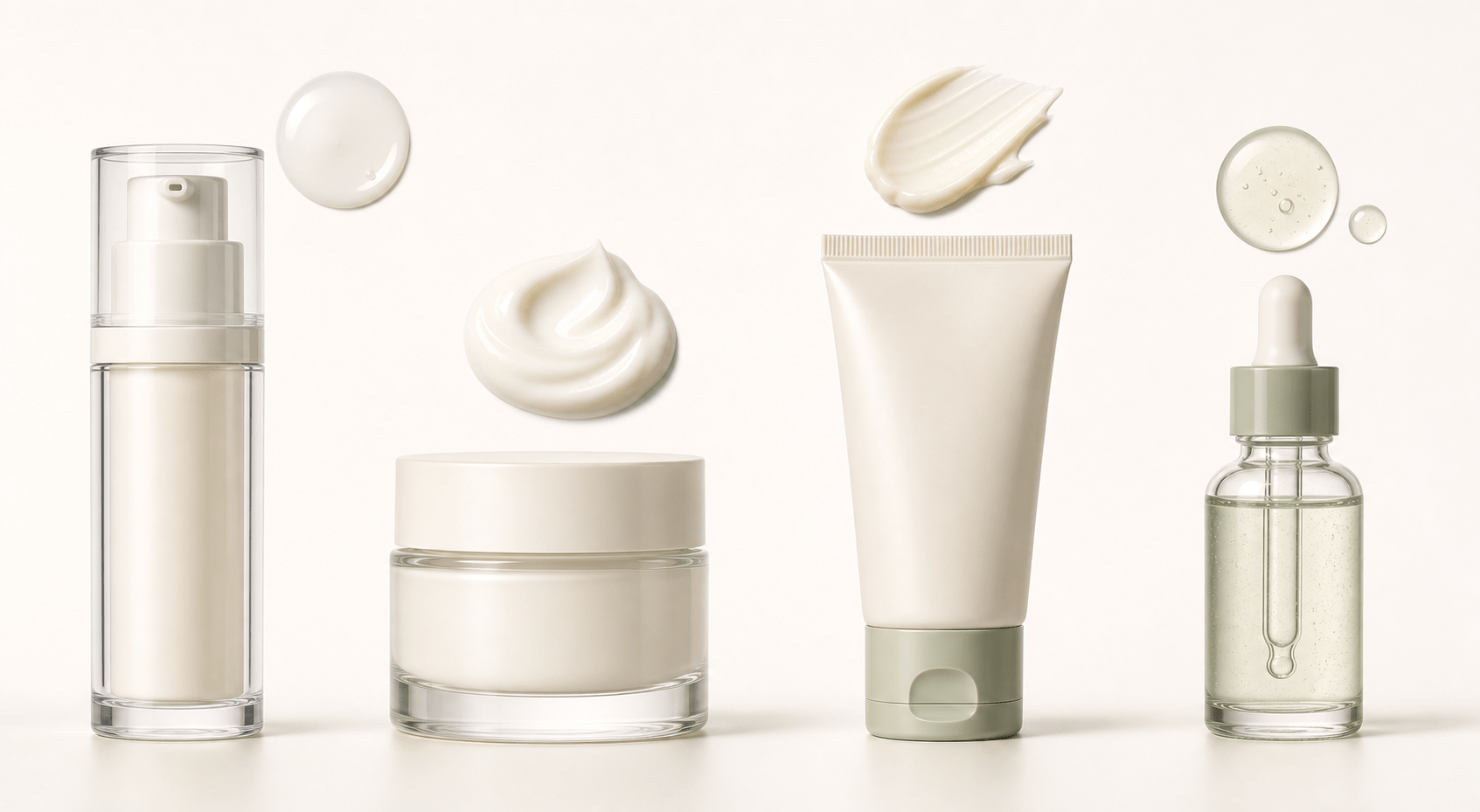
Each packaging format offers a different balance of protection, cost, appearance, and usability.
Cosmetic bottles
Bottles are suitable for lotion, toner, cleanser, serum, shampoo, and body-care products. They can be paired with lotion pumps, treatment pumps, sprayers, disc-top caps, or screw caps. When selecting a bottle, confirm the neck size, closure compatibility, dosage per stroke, and dip-tube length.
Cream jars
Jars are widely used for face cream, masks, body butter, balm, and scrub. Options include PET, PP, glass, acrylic-style double-wall constructions, and refillable designs. Ask whether the jar includes an inner lid or sealing liner and whether the opening is suitable for the formula and filling equipment.
Cosmetic tubes
Tubes work well for cleanser, sunscreen, hand cream, eye cream, and travel products. Common choices include PE, PBL, ABL, and PCR structures. The supplier should help confirm the diameter, tube length, wall structure, cap style, orifice size, and decoration method.
Airless packaging
Airless bottles are often selected for premium skincare and formulas that benefit from controlled dispensing. However, “airless” does not automatically mean that every formula will work. The piston, pump engine, dosage, and viscosity range must be evaluated together.
3. Compare packaging materials
Material affects clarity, weight, chemical resistance, recyclability, price, and visual positioning.
- PET: Lightweight, clear, and widely used for bottles and jars.
- PETG: Offers excellent clarity and a premium appearance, but cost and recycling requirements should be reviewed for the target market.
- HDPE: Durable and suitable for many personal-care products, especially when a softer, opaque appearance is acceptable.
- PP: Commonly used for jars, caps, airless components, and mono-material packaging concepts.
- Glass: Provides a premium feel and strong barrier properties but increases weight and breakage risk during transport.
- PCR plastic: Can support sustainability targets, although color variation, odor, availability, and PCR percentage must be discussed early.
For sustainability claims, ask the supplier for material documentation and avoid making broad environmental claims that cannot be supported. The best option depends on the product, local recycling infrastructure, and the markets where the skincare line will be sold.
4. Set a realistic target cost and MOQ
New brands often focus on unit price without calculating the complete packaging cost. Your budget should include the container, pump or cap, decoration, mold or tooling fees, samples, testing, assembly, cartons, freight, duties, and expected waste.
MOQ can also differ by component. A bottle may be available in a low quantity while a custom-colored pump or printed cap requires a higher quantity. To control risk during the first launch, consider stock packaging with customized labels, silk-screen printing, hot stamping, or standard colors. Fully custom molds are better suited to projects with a proven sales forecast, sufficient development time, and a larger budget.
5. Plan the brand appearance and decoration
Packaging should express the brand clearly while remaining manufacturable. Common customization options include custom color, silk-screen printing, hot stamping, labeling, spray coating, matte or glossy finish, gradient coating, and metallization.
Send vector artwork and Pantone references whenever possible. Request a decoration sample or pre-production sample before approving mass production. Curved surfaces, small print areas, textured finishes, and color differences between plastic components can affect the final appearance.
6. Check filling-line and user compatibility
The package must work both in production and in the customer’s hands. Confirm how the product will be filled, capped, labeled, coded, and packed. Filling factories may need dimensional drawings, neck specifications, torque recommendations, pump priming information, and samples for line trials.
User experience matters as well. Test opening force, cap security, pump output, spray pattern, leakage resistance, product evacuation, grip, and travel performance. A beautiful package that leaks or dispenses poorly can create returns and damage the brand.
7. Test before mass production
Never rely only on an empty packaging sample. A practical approval process should include:
- Visual and dimensional inspection
- Formula compatibility testing
- Leakage and sealing tests
- Pump or sprayer performance tests
- Drop and transport simulation
- Decoration adhesion tests
- Filling-line trials when required
Testing conditions and acceptance criteria should be agreed with the packaging supplier and filling partner. Keep approved samples as references for production quality control.
8. Evaluate the cosmetic packaging supplier
A reliable supplier should do more than send a price list. Look for clear technical communication, accurate samples, realistic lead times, component-matching experience, quality-control procedures, and export support.
When requesting a quotation, provide the product type, formula characteristics, required capacity, packaging format, material preference, closure, decoration, target quantity, delivery country, and launch schedule. Complete information enables the supplier to recommend suitable options and quote more accurately.
Frequently asked questions
What packaging is best for a new skincare brand?
There is no single best package. The right choice depends on formula compatibility, target customer, budget, order quantity, filling method, and brand positioning. Stock bottles, jars, or tubes with customized decoration are often practical for a first launch.
What is the typical MOQ for custom cosmetic packaging?
MOQ varies by packaging type, material, color, decoration, and component. Stock packaging may support smaller orders, while custom colors, printing, or private molds generally require higher quantities. Ask for the MOQ of every component, not only the main container.
Should I test the formula in the package?
Yes. Compatibility and functional testing with the actual formula should be completed before mass production. The brand or formula owner should define the final test protocol and acceptance standards.
How early should packaging sourcing begin?
Start as early as possible. Packaging selection, samples, formula testing, artwork approval, production, and shipping can take several months, especially when custom colors, decoration, or molds are required.
Build a practical packaging plan for your launch
The best skincare packaging combines formula protection, reliable dispensing, attractive design, realistic cost, and scalable production. Begin with clear product requirements, compare suitable materials and formats, test the complete pack, and work with a supplier that can support sampling, customization, quality control, and export delivery.
Planning a new skincare line? Tell AC Skincare Packaging your product type, formula, capacity, target quantity, and design direction to receive suitable bottle, jar, tube, pump, and customization recommendations.