Sep 7, 2026Packaging Information
Cosmetic Packaging Self-Declaration Support: What Data Should Suppliers Provide?
Learn what suppliers should provide for a cosmetic packaging self-declaration: component materials, PCR evidence, decoration records and batch traceability.

• Byadminn
• On2026-08-05
• InPackaging Information
A cosmetic packaging self-declaration should be supported by product-specific technical evidence, not by a one-page supplier statement alone. For beauty packaging, the useful evidence normally starts with a complete component list, material identification, drawings or specifications, PCR records where applicable, decoration details, test reports, and traceability from the approved model to production batches.
This article explains what packaging suppliers can prepare to support a brand, importer, or other responsible economic operator. It is practical sourcing guidance, not legal advice. The exact compliance route depends on the packaging, product, destination market, supply-chain roles, and the rules in force when the packaging is placed on the market.
Content Menu
• Key Takeaways
• What Is a Cosmetic Packaging Self-Declaration?
• What Are the Roles of the Brand, Importer, Manufacturer, and Supplier?
• What Data Should Packaging Suppliers Provide?
• How Should a Component Material List Be Prepared?
• What PCR Data Should Be Collected?
• Why Must Decoration Processes Be Recorded?
• How Should Model and Batch Traceability Work?
• What Should Buyers Check Before Accepting a Supplier File?
• Frequently Asked Questions
Key Takeaways
• A supplier declaration can support a compliance file, but it does not automatically replace the manufacturer’s conformity assessment or EU declaration of conformity.
• Documentation should identify the exact packaging type, component revision, material, decoration, supplier, and applicable production batch.
• A bill of materials should cover every relevant part, including small pump, gasket, liner, wiper, dip-tube, label, coating, and closure components.
• PCR claims require a documented calculation basis and supply-chain evidence; purchase records alone may not prove the recycled percentage in a finished package.
• Changes to resin, colorant, coating, print system, closure, or sub-supplier should trigger a documented review.
• Brands and importers should have a controlled evidence pack before approving claims or placing packaging on the market.
What Is a Cosmetic Packaging Self-Declaration?
In packaging compliance, “self-declaration” usually describes a responsible economic operator declaring that specified packaging meets applicable requirements, based on evidence kept in a technical file. It should not be confused with a supplier’s general statement that a material is “compliant,” “recyclable,” or “eco-friendly.”
For the EU market, Regulation (EU) 2025/40 on packaging and packaging waste (PPWR) requires manufacturers to carry out a conformity assessment, prepare technical documentation, and draw up an EU declaration of conformity when compliance has been demonstrated. The PPWR entered into force on 11 February 2025 and generally applies from 12 August 2026, according to the European Commission’s packaging-waste overview. Article 39 states that, by drawing up the declaration, the manufacturer assumes responsibility for packaging compliance.
This makes the evidence chain important. The signed declaration is the conclusion; the drawings, material data, calculations, assessments, and test reports are the support underneath it. Annex VII of the official PPWR text describes technical documentation that can include a general packaging description, intended use, design and manufacturing drawings, component materials, applied standards or specifications, assessment methods, and test reports.
What Are the Roles of the Brand, Importer, Manufacturer, and Supplier?
The role is determined by the legal definitions and the real supply-chain arrangement, not only by the title used on a purchase order.
PPWR Article 16 specifically requires suppliers to provide manufacturers with the information and documentation necessary to demonstrate conformity. Article 18 requires importers to ensure that the conformity assessment and technical documentation have been completed. Buyers should therefore agree on document responsibilities before ordering—not after a retailer or authority asks for evidence.
What Data Should Packaging Suppliers Provide?
A supplier file should let a buyer identify the packaging, understand its composition, follow the manufacturing revision, and connect claims to evidence. The following items are a practical starting set:
• Product identification: supplier name, manufacturing site where relevant, model number, customer model number, description, nominal capacity, drawing number, revision, and intended packaging function.
• Approved specification: dimensions, weights, tolerances, neck or thread details, closure fit, pump output where applicable, color standard, appearance criteria, and pack configuration.
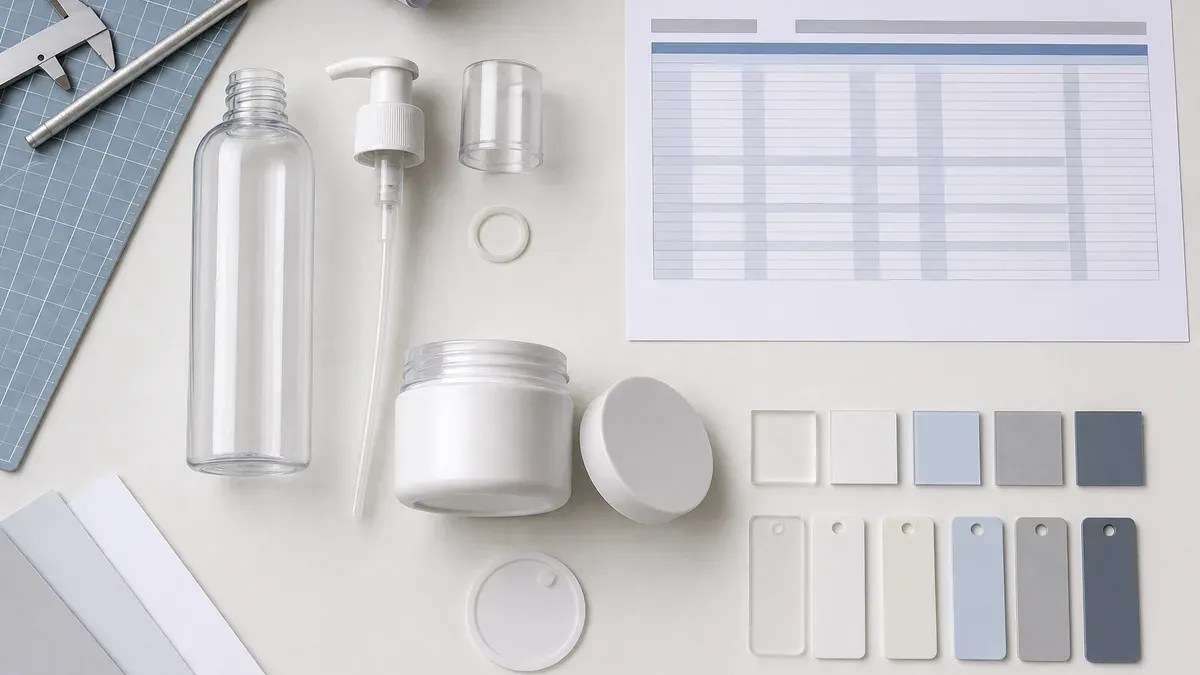
• Component bill of materials: each bottle, jar, tube, pump part, cap, overcap, liner, gasket, wiper, dip tube, label, adhesive, ink, coating, and decorative layer.
• Material evidence: resin grade or controlled material reference, technical data, supplier declarations, restrictions, and supporting tests appropriate to the market and intended use.
• Manufacturing information: molding or converting process, assembly steps, critical sub-suppliers, and controls used to keep series production consistent.
• Decoration records: substrate, pretreatment, ink or coating system, artwork version, print position, coverage, curing method, and decorative sub-supplier.
• Test evidence: reports relevant to the applicable requirements and intended use, clearly linked to the tested sample and revision.
• PCR evidence: source documentation, batch declarations, chain-of-custody information, calculation basis, and finished-component allocation.
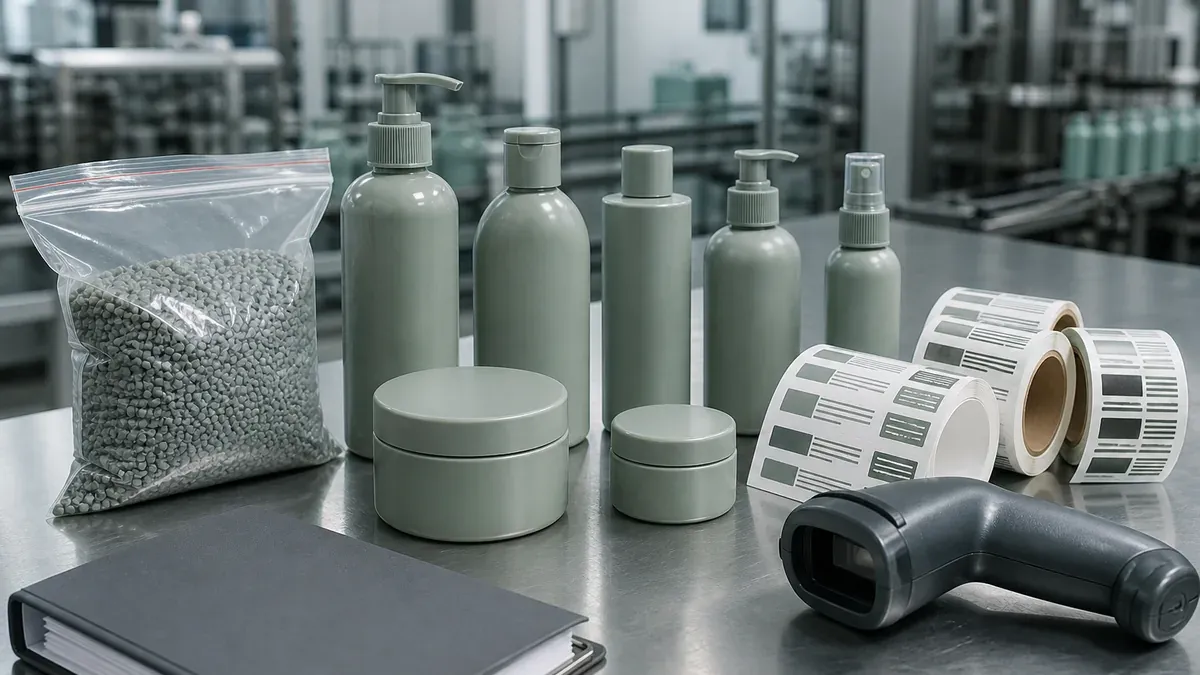
• Traceability records: raw-material lot, production order, machine or line where useful, date, inspection lot, finished-goods lot, and shipping lot.
• Change history: what changed, why, when, affected batches, review result, and buyer approval where required.
Buyers can combine this documentation review with the operational checks described in the company’s guide to custom skincare packaging before mass production.
How Should a Component Material List Be Prepared?
The component material list should describe the real assembly, not only the main container resin. A lotion bottle described simply as “PET with PP pump” may omit a PE dip tube, elastomer seal, metal spring, ball, color masterbatch, label, adhesive, and coating. Those omitted parts can matter to material calculations, restricted-substance reviews, recyclability assessments, and claims.
Use one row per component or homogeneous material layer:
For multi-layer bottles, laminated tubes, metallized parts, labels, and coatings, record the layers separately where practical. If an exact formulation is confidential, a controlled supplier reference and an adequate compliance statement may be used, but the buyer still needs enough evidence to assess the applicable requirement.
What PCR Data Should Be Collected?
PCR documentation should establish what the recycled material is, where it entered the process, how its percentage was calculated, and which finished batches received it. A vague certificate saying “contains recycled plastic” is not enough for a precise percentage claim.
A practical PCR pack may include:
• recycler and resin-supplier identification;
• material and batch numbers;
• definition of post-consumer feedstock used for the claim;
• chain-of-custody or traceability records;
• incoming quantity and production consumption records;
• calculation method, system boundary, allocation method, and unit;
• PCR percentage for each relevant component—not only for the total purchase;
• mass-balance or controlled-blending rules where used;
• third-party verification details when required or commercially requested;
• links between PCR lots, molding batches, finished-goods batches, and shipments.
PPWR requires the Commission to establish a methodology for calculating and verifying recycled content and a technical-documentation format by 31 December 2026. Therefore, as of 5 August 2026, buyers should avoid presenting a private spreadsheet as the final universal PPWR method. Build traceable source data now, then check the adopted implementing rules before making or approving a regulated claim.
This topic is separate from formula compatibility and visual variation. Brands considering recycled resin should also review the site’s practical discussion of PE and PCR packaging materials, while independently validating any market-specific compliance statement.
Why Must Decoration Processes Be Recorded?
Decoration changes the finished packaging. A coating, ink, metallized layer, foil, label, adhesive, or sleeve may add materials, affect component weight, introduce substances, cover sorting cues, or change how the pack is assessed. For this reason, an undecorated bottle test report should not automatically be treated as evidence for every decorated version.
The decoration file should identify the base substrate, pretreatment, process, material system, supplier, artwork revision, coverage, curing conditions, and approved sample. Record whether the decoration is internal or external and whether it can contact the formula during filling, wiping, or consumer use.
When a brand changes from screen printing to spray coating, adds hot stamping, changes label adhesive, or selects a new decorative supplier, the change-control record should ask:
• Does the bill of materials change?
• Does any previous test remain representative?
• Does component weight or material allocation change?
• Could the decoration affect recyclability, labelling, compatibility, or claims?
• Does the approved artwork or product model need a new revision?
How Should Model and Batch Traceability Work?
Traceability should answer two questions: “What exactly was supplied?” and “Which records support this shipment?” The system does not need to be complex, but its identifiers must be consistent.
A workable chain is:
• Assign a supplier model number and controlled drawing revision.
• Map it to the customer’s SKU or packaging reference.
• Record approved materials, sub-suppliers, colors, and decoration versions.
• Give each production order and finished inspection lot a unique identifier.
• Link incoming material lots to the production order.
• Link finished lots to cartons, packing lists, invoices, and shipping records.
• Retain samples or images where useful and record any deviation approval.
• Keep a change log so an old report is not applied to a new construction without review.
A batch code should not exist only on an internal spreadsheet. The physical carton, pallet, or product label should carry a reference that can be reconciled with production and inspection records. For a complete product line, repeat the logic for each bottle, jar, tube, pump, and closure. The site’s overview of cosmetic packaging options illustrates why model-level control is needed across different packaging formats.
What Should Buyers Check Before Accepting a Supplier File?
• Is the legal role of each party clear?
• Does the file identify the exact model, drawing revision, decoration, and intended use?
• Are all components and material layers included?
• Are the test samples representative of the supplied packaging?
• Can PCR data be traced from source evidence to finished batches?
• Are dates, document versions, issuers, and validity conditions visible?
• Are confidential references controlled rather than replaced with vague claims?
• Is there a change-notification agreement?
• Can the importer or manufacturer retrieve the evidence within the required time?
Do not ask a supplier to guarantee the brand’s full market compliance without defining the packaging, formula interaction, market, claims, and legal roles. A better request is for accurate, controlled source data that the responsible economic operator can assess and incorporate into its technical documentation.
Frequently Asked Questions
Can a supplier issue the EU declaration of conformity for a beauty brand?
It depends on the supplier’s legal role. Under PPWR, the manufacturer draws up the EU declaration after the conformity assessment demonstrates compliance. A component supplier can provide supporting declarations and technical evidence, but that does not automatically make it the legal manufacturer or transfer responsibility from the operator placing packaging under its name or trademark.
Is a material safety data sheet enough for packaging self-declaration?
No. An SDS serves a different purpose and generally does not identify the complete packaging construction, finished component weights, intended use, decoration, applicable requirements, conformity assessment, or batch traceability. It may be one input, but the technical file normally needs product-specific specifications, material records, assessments, and test evidence.
Should every small pump component appear in the bill of materials?
Relevant components should be captured, including springs, balls, gaskets, dip tubes, liners, and overcaps. Suppliers may group parts when this remains technically accurate, but the file must contain enough detail for applicable material, substance, recycled-content, and recyclability assessments.
How should a supplier state the PCR percentage?
State the component, percentage, basis of calculation, system boundary, material source, batch or time period, and allocation method. Link the figure to purchase, production, and finished-batch records. Avoid presenting an estimate as a verified result. Check the final market-specific method before approving a regulated claim.
Does a new color require a new compliance review?
At minimum, it requires documented change review. A new masterbatch or coating can change material composition, supplier references, decoration coverage, and the representativeness of earlier tests. The review should decide whether existing evidence remains applicable or whether updated documents or tests are needed.
How long should packaging compliance records be retained?
Retention depends on the applicable rule and packaging type. Under PPWR, manufacturers keep technical documentation and the EU declaration for five years for single-use packaging and ten years for reusable packaging from the relevant market-placement date. Other rules or contracts may require different periods.
Can one declaration cover a family of bottles and jars?
Only when the family is technically defined and the evidence is representative. Different capacities, resins, colors, closures, decorations, and manufacturing sites can change the assessment. A declaration should clearly identify the covered types and revisions rather than use an open-ended phrase such as “all cosmetic packaging.”
Practical Summary
Cosmetic packaging self-declaration support begins with controlled source data. Suppliers should document the complete assembly, component materials, PCR evidence, decoration, specifications, tests, model revisions, and batch history. Brands, manufacturers, and importers can then evaluate that evidence against their actual role, market, product, and claims. A declaration is credible only when its scope can be traced to the packaging that was produced and shipped.
Guangzhou AC Skincare Packaging Co., Ltd. supplies customized packaging solutions for skincare, cosmetic and personal care brands. Our product range includes plastic bottles, airless bottles, cream jars, cosmetic tubes, pumps, closures and sustainable packaging options.
Website: https://www.skincarepkg.com/ Email: [email protected] Phone / WhatsApp: +86 18688407515
Planning a new skincare packaging project? Send us your required capacity, material, decoration, quantity and reference images. Our team can help review the packaging options before sampling and mass production.